
When Power Borrows the Language of Worship
What an AI image of Donald Trump reveals about loyalty, control, and why none of it breaks anything.


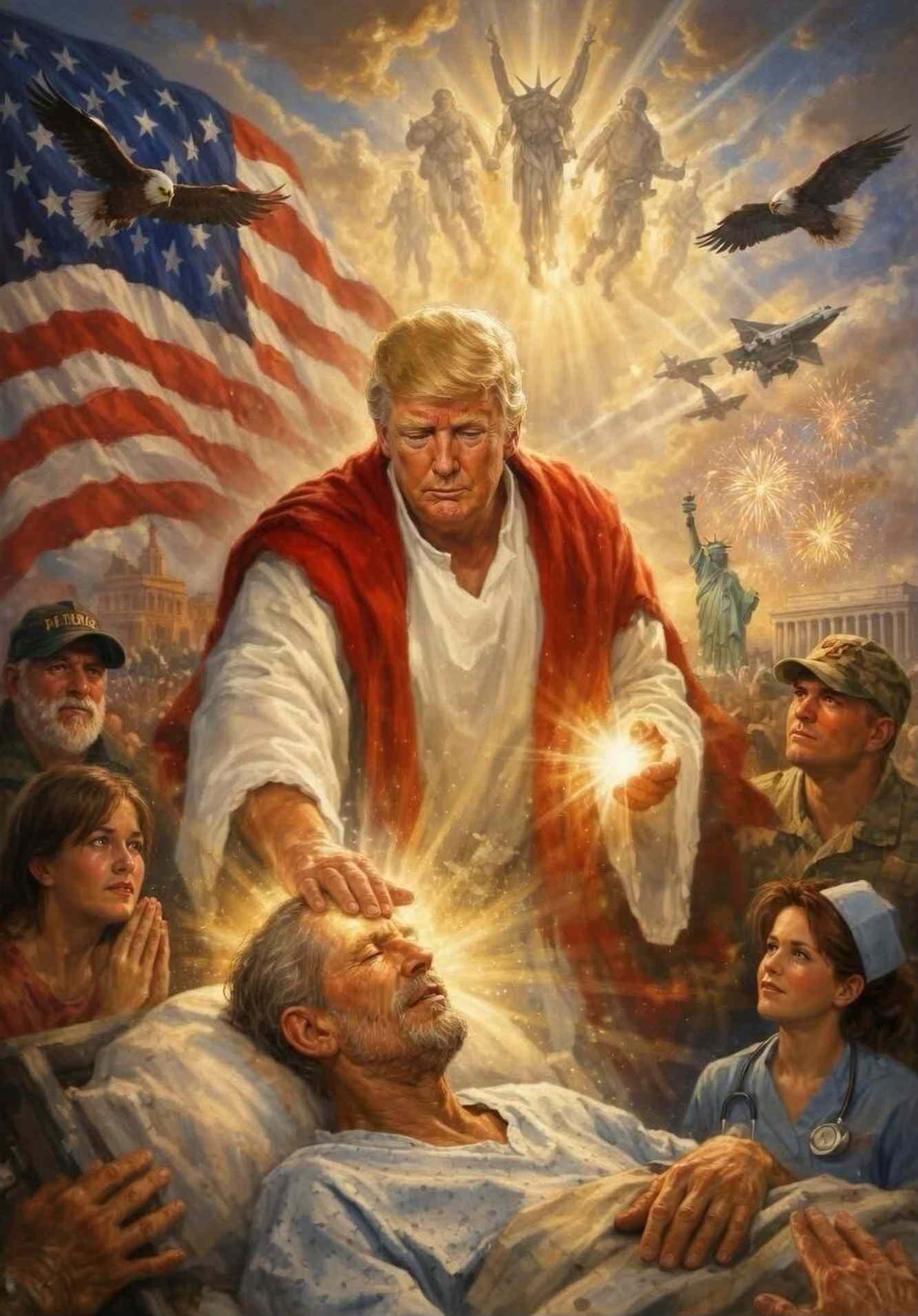
Growing up in church, there was a figure we talked about a lot.
No. Not Jesus.
The other guy.
Every tradition had its own version of the warning, but the gist of it was always the same: someday… a powerful political figure would rise up and deceive even the most devoted believers. Even some of the elect (that’s the word we used for us lucky few) would be fooled. Not the pagans, not the openly rebellious. The people who had spent their whole lives trying to get it right.
Which scarred the crap out of me. Because we’re all trying to get it right, trying to pay attention. And now you’re telling me, that even when we do ALL of that… some of us are still going to fall for it?
Eventually, I heard that warning so many times it stopped having the same impact. As I got older and started reading/thinking for myself I realized that it’s not actually a thing and left it behind (see what I did there). I’ve spent enough time in the Gospels to understand the tradition was better when it stayed close to what Jesus said and did, instead of trying to map current events onto Revelation.
But there’s something about warnings you heard a thousand times as a kid that just doesn’t fully leave you.
So as images and videos and depictions of Trump as a messiah figure started to emerge, I couldn’t help but recall all those warning. And if I did still hold to those old beliefs, my radar would have gone wild when Trump posted the AI-generated image of him depicted as Christ with all the trappings… the robes, the light, the whole visual vocabulary of Christian iconography.
The image didn’t really shock me. I mean, it completely tracks for a malignant narcissist who uses Christianity to gain and keep more power/money/influence. It’s almost predictable.
No. It was the response after that shocked me. Not the initial outcry but how the explanations changed almost immediately after.
The Explanation That Wasn’t One
After that first wave of righteous indignation from the MAGA Christians, I began to see something else show up to help reframe the whole situation. JD Vance [1] went on Fox News and claimed that Trump was joking and that he likes to mix it up on social media. Trump [2] claimed he thought it was showing him as a doctor, maybe from the Red Cross. Some suggested it had been misunderstood and that it showed Trump doing God’s work.
Regardless of the explanation, it stopped being about what Trump did and started being about how we’re perceiving it.
We’re being too sensitive.
We’re taking it out of context.
We just don’t get it.
Same image. Multiple explanations. None of them replaced the others.
In most situations, that would create enough friction to make people slow down and ask… which one is it? But that did not happen here. At all.
The explanations didn’t cancel each other out. They stacked. And depending on what you needed, you picked the one that let you move on.
What High-Control Environments Actually Do
Steven Hassan has spent decades studying how influence works in high-control groups; everything from classical cults to modern political movements. His BITE Model (Behavior, Information, Thought, and Emotional control) lays out how these environments maintain loyalty.
Instead of enforcing one clear narrative, it protects the leader from consequences of contraction. [3] The details can shift all the need to. However, the core remains in place.
Once that structure is in place, contradiction doesn’t force a reckoning. It gets absorbed. The pressure doesn’t stay on the leader to clarify. It moves to everyone else to interpret.
So now the issue isn’t what was posted. It’s how you’re reacting to it.
If you’re bothered, you’re overreacting.
If you press for clarity, you’re missing the joke.
If you take it seriously, you become the problem.
Understanding that helps us see how the structure automatically moves the responsibility away from the leader and onto everyone else. Which means, it’s the shifting of that responsibility that matters far more than the AI image ever could.
Once that becomes the norm, the standard changes. It’s no longer about whether something makes sense. It’s about whether you stay aligned.
The Language That Keeps It Moving
Amanda Montell, a linguist and the author of Cultish, writes about how groups built on loyalty use language differently.[4] They don’t need one fixed explanation that holds up under pressure.
They rely on constant reframing. Meaning stays just fluid enough that followers are always adjusting in real time. They’re constantly reinterpreting, filling in gaps, extending the benefit of the doubt without even realizing they’re doing it.
And that shift in thinking is so subtle it’s almost sinister. It doesn’t feel like you’re abandoning clarity. It feels like you’re being reasonable. You start to assume there’s probably a better explanation just out of reach, and your job is to find it instead of question why it isn’t clear in the first place.
After a while, you stop expecting anything to fully line up.
You just stay with the group.
The explanations around that image followed that pattern almost exactly: it’s trolling, it’s symbolic, it’s satire, it’s misunderstood, it’s out of context, it’s not a big deal. Each one lowers the stakes just enough to keep things moving.
They don’t need to agree with each other. They just need to be there so the moment never quite settles into something you have to deal with directly.
What It Does to the People Inside It
If you’re a regular person within the group, you start adapting to this without realizing it. You learn pretty quickly which questions are out of bounds, or which ones make things tense in a way that feels… unnecessary. So you stop asking those.
You get quicker at reframing. Someone brings something up, and before it even fully lands, you’re already reaching for a way to soften it, or redirect it, or put it into a frame that keeps everything nice and neat. You find ways to keep conversations moving so they don’t stall out in places where things don’t quite add up.
No one sits you down and teaches you that.
It just becomes instinct.
And it doesn’t feel dishonest. That’s the thing. It feels like you’re the one being fair. Like you’re not jumping to conclusions. Like you’re seeing the bigger picture instead of getting hung up on one moment.
Over time, though, the line between belief and defense starts to blur. You’re not just agreeing with something anymore. You’re the one that’s helping hold it all together. You’re carrying that weight of making it seem coherent in your own thinking and in the conversations you're having with people outside of it.
Which is why, if you’ve ever had a conversation with a MAGA supporter, it can feel like you’re talking past each other. They’re not just repeating talking points. They really believe what they’re saying, even when it sounds completely disconnected from what you’re seeing.
For them, it just… is.
And that’s what makes this so easy to miss. Because it doesn’t look like someone being manipulated in some obvious, dramatic way. It looks like a normal person, standing right in front of you, making sense of the world the only way that still holds everything together.
That may seem really small or subtle, but once it happens, it changes everything about how reality gets processed.
The Part I Can’t Shake
I’m not writing this as someone who thinks the end times are unfolding or that Donald Trump fits into some prophetic script. I walked away from that framework for reasons I still stand by.
However, I did grow up in a tradition that warned over and over about a specific kind of danger… a power that wraps itself in sacred imagery, that fuses political authority with religious identity, that asks for a kind of devotion it was never meant to receive… and how the Gospels constantly push against that danger.
Jesus resists power that elevates itself. He moves toward the margins. He refuses the kind of authority people keep trying to hand him. The center of the story isn’t dominance. It’s humility. It’s self-emptying.
So when I see that imagery attached to a political figure, and then watch how quickly the meaning gets reshaped… I don’t need an apocalyptic framework to feel the weight of it.
I’ve seen this before. I mean, not like this or at this scale. But close enough to recognizing it for what it is.
And maybe that’s the part that stays with me.
Not just that it happened.
But how easily it was normalized.
[^1]: JD Vance’s television comments defending the image as humor were widely reported. See, for example, coverage from NBC News and Politico in the days following the post.
[^2]: Trump’s comment suggesting the image depicted him as a doctor was reported by multiple outlets. See The Guardian and CNN coverage of the post and its aftermath.
[^3]: Steven Hassan, Freedom of Mind: Helping Loved Ones Leave Controlling People, Cults, and Beliefs (Freedom of Mind Press, 2012). Hassan’s BITE Model is also outlined at freedomofmind.com.
[^4]: Amanda Montell, Cultish: The Language of Fanaticism (Harper Wave, 2021).
 | A guest post by
|
Great article!