
When Empathy Becomes a Sin
The Weaponization of Obedience and the Death of Compassion

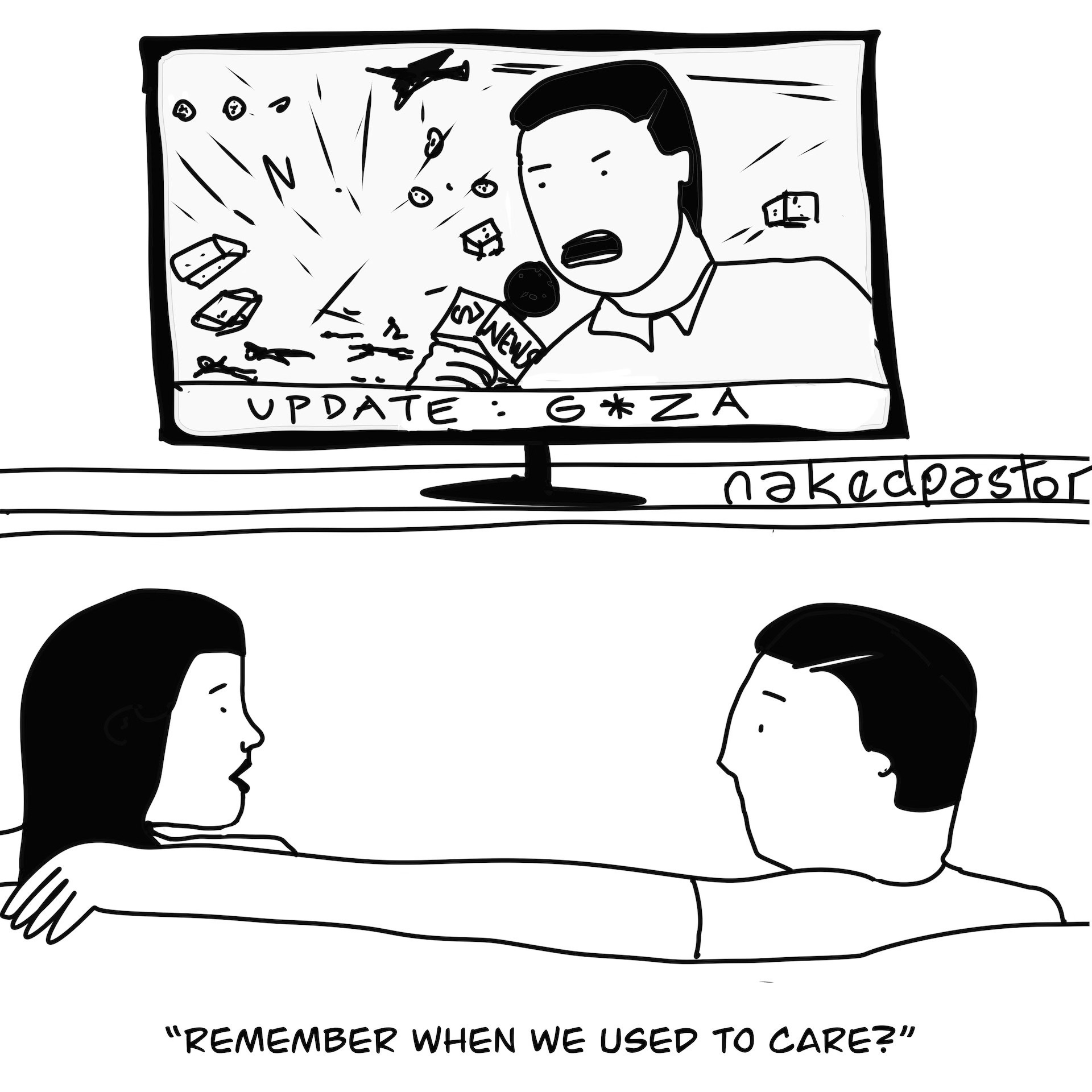
David Hayward aka NakedPastor
This essay is the third installment in this week’s series on Vertical Morality — tracing how obedience-based faith distorts empathy, shapes our politics, and numbs our humanity. If you missed the earlier pieces, you can start with “The Rotten Fruit of Obedience” and “The God of the Strongman.”
I’ve always been a rule follower.
Even as a kid, I was the one who worried about getting caught. Sure, I did dumb kid stuff — snuck extra cookies, stretched my bedtime — but I never strayed too far. I was consequence-driven by nature. If there were boundaries, I wanted to know exactly where they were, and what would happen if I crossed them.
That’s why fundamentalism made so much sense to me in my early years.
It spoke to that part of me that equated safety with certainty, order with goodness, obedience with love. It gave me clear lines to stay inside, and promised that if I followed them, I’d be okay — with God, with my community, with myself.
I used to think obedience was the highest form of faith.
The more you surrendered, the holier you were.
The more you silenced your questions, the more God was pleased.
It sounded noble. It even felt safe.
But I didn’t realize what I was sacrificing in the process.
Because eventually, the longer you practice that kind of faith, the quieter your empathy becomes.
Abraham and the Sanctioning of Cruelty
We love to preach the story of Abraham and Isaac.
How Abraham’s willingness to sacrifice his son proved his faith.
How obedience mattered more than understanding.
But no one ever asked the obvious question:
What kind of God would demand that?
And what happens to our humanity when we learn to applaud it?
That story gets used to sanctify cruelty — to make it sound holy when we hurt people “for their own good.”
It becomes a divine permission slip for harm.
That’s the theology behind every parent who says, “I can’t accept my gay child, but I love them anyway.”
Behind every politician who insists that separating families is “necessary to protect the nation.”
Behind every pastor who says, “We must speak the truth in love,” right before using Scripture like a weapon.
It’s the same story retold — obedience first, empathy last.
The Simplest Stories Are the Most Dangerous
Literalism is comforting because it removes the burden of wrestling.
It tells us faith can stay clean and simple if we just stop asking complicated questions.
Take that story of Abraham sacrificing his son Isaac, for instance.
We lift that story out of its ancient world — away from its Hebrew context, away from the layered symbolism and communal meaning it once carried — and flatten it into a simple command-and-obey morality tale.
In doing so, we lose the deeper spiritual truth the story was trying to reveal.
These ancient narratives weren’t written as modern instruction manuals. They were sacred wrestling matches — stories meant to provoke, not pacify; to hold a mirror up to human fear and faith, not to bless violence. But when we strip them of context, we turn them into proof texts that make obedience sound holier than compassion.
And that’s how we end up with sermons that give permission to harm, with people quoting Abraham’s test as if God’s highest calling is our willingness to hurt someone we love in His name.
Literalism can only survive when we refuse to see the layers — when we prize clarity over curiosity. It’s appealing because it feels safe, especially for people raised in systems where questioning authority meant risking belonging.
Our nervous systems are wired to equate acceptance with survival.
So when we’re told that ambiguity is rebellion, our bodies respond as if our safety is on the line. Religious ambiguity doesn’t just threaten belief — it threatens belonging.
That’s why influencers like Allie Beth Stuckey can write entire books claiming that “empathy is a sin” and find massive audiences for it. She isn’t inventing something new; she’s repackaging an old theology of control — one that teaches people that compassion will corrupt them, that feeling too deeply makes them unfaithful, that softness is a threat to holiness.
It sounds strong and resolute. But it’s fear disguised as faith.
The paradox is this: the more we cling to certainty, the less human we become.
Because empathy requires tension. It asks us to stay present in the gray.
And if you’ve been taught that God only lives in the black and white, you’ll start to see compassion as compromise.
That’s how cruelty becomes virtue — not because people are evil, but because they’re afraid of being cast out.
When “Tough Love” Becomes Spiritual Abuse
“Tough love” is one of those phrases that sounds noble until you’re on the receiving end of it.
It’s the religious rebrand of control — punishment dressed up as righteousness, detachment baptized as wisdom.
I’ve heard it in sermons, in parenting books, in political speeches — this insistence that love must be policed or it will lose its power.
“Don’t enable sin.”
“Sometimes love means saying no.”
“Spare the rod, spoil the child.”
It all sounds so responsible, so biblical. But underneath the slogans is a deep fear — that love left to itself will be too soft, too forgiving, too uncontrollable.
And that fear becomes systemic.
It’s how we justify cruelty and call it conviction.
It’s how we frame exclusion as protection.
It’s how spiritual abuse hides inside language that claims to “care.”
This is where theology stops being theory and starts shaping our nervous systems.
Because when compassion is shamed as weakness, we begin to suppress it — in our churches, in our families, and eventually, in ourselves.
We convince ourselves we’re defending holiness,
when all we’re really defending
is hierarchy.
The Cost of Certainty
The cost of this obedience is subtle at first — a small numbing, a quiet disconnection.
You learn to swallow discomfort before it reaches your conscience.
You start filtering compassion through doctrine, measuring whether someone’s pain is “deserved” before allowing yourself to care.
At first, it just feels like maturity — like you’ve learned to be disciplined, discerning, faithful. But underneath that calm is a slow corrosion.
Because when you’re trained to see obedience as love, you start policing your own tenderness. You begin to flinch when compassion rises — wondering if it’s weakness.
You start mistrusting your own tears.
That’s how moral detachment takes root.
You stop noticing suffering unless it fits your moral framework.
You stop listening unless someone has the right vocabulary.
You stop feeling unless the feeling is approved.
And eventually, empathy itself starts to feel dangerous — like a slippery slope toward compromise.
That’s how we end up with Christians who can scroll past a photo of a drowned child at the border and quote Romans 13 about “obeying the law.” It’s how pulpits start to sound more like press conferences — people reciting talking points about order instead of mourning lost lives.
Because once empathy becomes a sin, detachment starts to look like faithfulness.
And the more detached we become, the more we mistake numbness for peace.
We call it spiritual maturity.
But it’s really just self-protection — sanctified.
The God of Law vs. the God of Love
But then there’s Jesus.
The one who touched lepers when the law said, Don’t touch.
Who healed on the Sabbath when religion said, Wait until tomorrow.
Who defended a woman caught in adultery when Scripture said, Stone her.
Who broke purity codes, redefined family, and kept showing up in all the wrong places with all the wrong people — and called it the Kingdom of God.
Every story that got him in trouble was a story about love — not sentimental love, but the kind that refuses to let rules get in the way of mercy.
He didn’t just teach compassion; he lived it with his body.
He reached across every boundary that fear had built and said, Here, too. God is here, too.
Jesus didn’t come to erase the law but to reveal its heart — and that heart was always love.
He lifted love over verses, not because Scripture didn’t matter, but because people did.
Whenever the letter of the law collided with the needs of a human being, Jesus chose the person every single time.
And if Jesus shows us what God is like,
then God is not the one demanding sacrifice — God is the one interrupting it.
God is not the voice commanding obedience at all costs —
God is the voice that says, Stop. There’s a better way.
This is what vertical morality can’t comprehend.
Because once love starts breaking rules, the whole system trembles.
It loses its leverage. It can’t control people who are free enough to choose compassion over compliance.
That’s why the religious gatekeepers called Jesus dangerous.
Because he was.
He was dangerous to any system that used God to protect power instead of people.The Mirror We Avoid
Sometimes I wonder if the story of Abraham was never meant to celebrate obedience, but to confront us with our capacity for violence in God’s name.
Maybe the real test wasn’t whether Abraham would sacrifice his son — but whether he would finally hear the voice that said, Stop.
Maybe faith isn’t measured by what we’re willing to destroy for God,
but by what we refuse to destroy because of God.
If empathy has become sin, then what kind of god are we left with?
A god who demands pain to prove loyalty?
A god who rewards hardness over heart?
A god who looks suspiciously like the men in power?
That’s not the God Jesus revealed.
Because when Jesus said, “I desire mercy, not sacrifice,” he wasn’t offering poetry — he was dismantling an entire system.
The Invitation
So maybe holiness was never about suppressing empathy.
Maybe it’s about trusting it.
Maybe the ache you feel when someone suffers isn’t rebellion — it’s recognition.
It’s the image of God in you responding to the image of God in them.
It’s the divine pulse that religion tried to domesticate but could never quite kill.
Maybe that still, small voice that whispers “this isn’t love” is the same Spirit that once whispered, “let the children come to me.”
Maybe the tug you feel toward mercy isn’t weakness — maybe it’s participation in the very heart of God.
Because if Jesus shows us what God is like, then empathy isn’t a liability to faith — it’s evidence of it.
It’s what happens when love stops being a doctrine and starts becoming a way of seeing.
If obedience has made us numb, compassion is how we wake back up.
If certainty has built walls around our hearts, empathy is how we find our way home.
And maybe that’s the scandal of grace —
that the holiness we were warned would ruin us
is the very thing that saves us.
Because the more I look at Jesus,
the more convinced I am that empathy was never the problem.
It was always the point.
Tomorrow we’ll close this series with Part Four —
Good Fruit, New Roots: Reclaiming a Faith That Grows Outward, Not Upward.
We’ll talk about what it means to rebuild — not around obedience and fear, but around the kind of love that actually bears life-giving fruit.