
What Do We Do With the Dead?
Finding a way to tell the truth about those who caused harm without surrendering my own humanity.

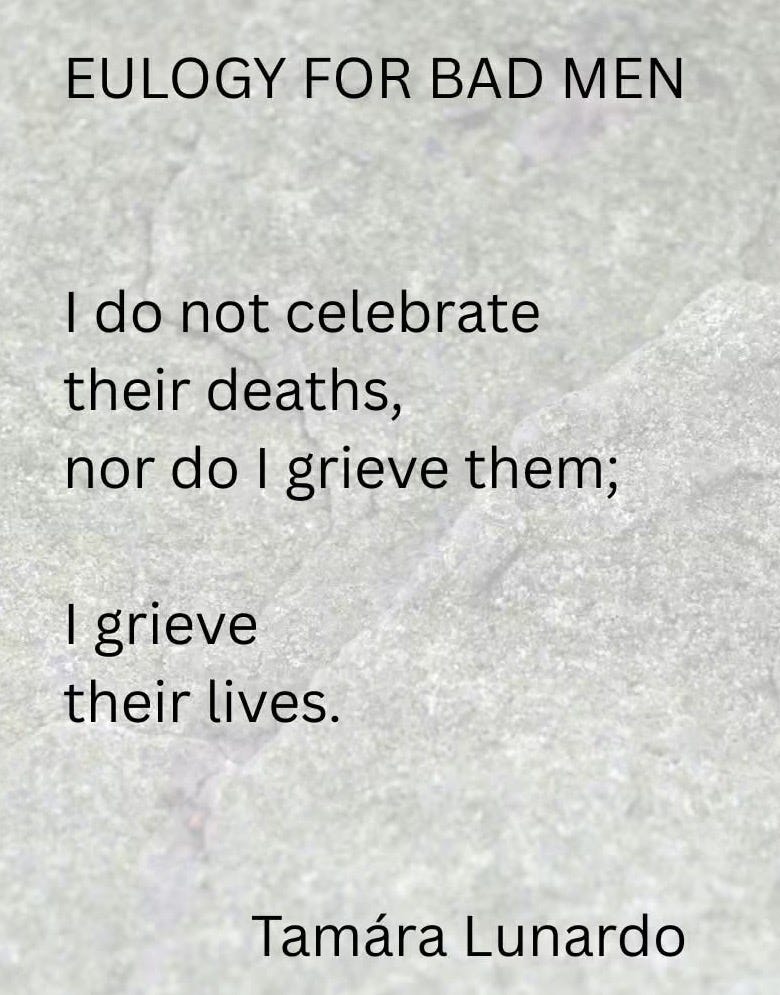
Tamára Perry-Lunardo, a good friend of mine, wrote something this week that has been echoing in my mind ever since I read it. She posted it in response to the death of Senator Lindsey Graham, in a piece titled “Eulogy for Bad Men.”
“I do not celebrate their deaths, nor do I grieve them; I grieve their lives.”
I haven’t been able to shake those words.
There are certain people whose deaths leave us in a strange place. They spent years using influence, power, or popularity in ways that wounded other people. Their words gave permission for cruelty. Their actions made life harder for people who were already carrying more than their share. When they die, there’s an unspoken expectation that we either speak well of them or say nothing at all. Tell the truth, and you’re accused of disrespecting the dead. Stay silent, and you end up participating in the same revisionist storytelling that let the harm go unchecked in the first place.
I’ve never been comfortable with either option.
I remember wrestling with this when the United States announced that Osama bin Laden had been killed. Crowds gathered in celebration. People waved flags, cheered, and treated another human being’s death like a championship victory.
I understood it. I still do. I would be lying if I said I’ve never felt that same pull, that same rush of relief when someone who caused enormous harm is finally gone. I’m not interested in judging the people who celebrated that night, or the people who celebrate now when someone like that dies. Many of them are carrying things I will never understand. They’ve experienced fear I’ve never felt, harm I’ve never bore. That relief is real. It’s human. I don’t think it makes anyone a bad person.
I think we want this to be either/or. Either you celebrate or you grieve. Either you feel the relief or you feel the sorrow. But the longer I sit with it, the more it feels like both/and, more than we probably want to admit. I can understand the celebration, even feel the pull of it myself, and still not be able to join it all the way. Something in me couldn’t fully rejoice over the death of another person, no matter what they had done. I just didn’t have the language for what I was feeling instead.
Tamara gave me that language: I grieve their lives.
That sentence doesn’t excuse anything. It doesn’t soften the damage or ask us to forget the people who suffered. It just refuses to let another person’s humanity disappear, even after they spent years denying the humanity of others.
That distinction is important to me. As someone who does their very best to follow the way of Jesus, I believe every person bears the image of God, and that people can spend an entire lifetime refusing to reflect that image back into the world. Every act of cruelty, every lie, every abuse of power is a life moving further from what it was made for. That’s what I grieve, not the death, but the distance.
I grieve the life that could have been. The relationships that were never healed. The chances to choose compassion over power that got left on the table. I grieve the people who will spend years recovering from damage someone else decided was acceptable.
This way of grieving protects something in me, too. The longer I do this work, the more convinced I become that hatred is contagious. Every time we decide someone is beyond compassion, we give away a small piece of our own humanity. We may feel justified, even righteous, but little by little, we start to resemble the very spirit we claim to oppose.
Following the way of Jesus has never asked me to pretend evil is good, or to rewrite history so the hard truths go down easier. It’s asked something harder: to tell the truth without surrendering the belief that redemption was always meant to be possible.
I don’t celebrate these deaths. I don’t pretend they don’t matter. I grieve lives that became cautionary tales instead of sources of healing, and a world where so much influence gets spent making life smaller for someone else.
Most of all, I grieve every moment when another image-bearer forgot who they were, and invited the rest of us to forget who we are too.
So profound and such a good way to deal with such deaths. Thank you for this
Profound. Thank you. I’m not celebrating any of it at this juncture. I’ve seen far too much death on every front the last 5 years.