
Sick and Tired
Weariness, clarity, and the refusal to forget

“I am sick and tired of being sick and tired.”
— Fannie Lou Hamer
That line has been sitting with me all day.
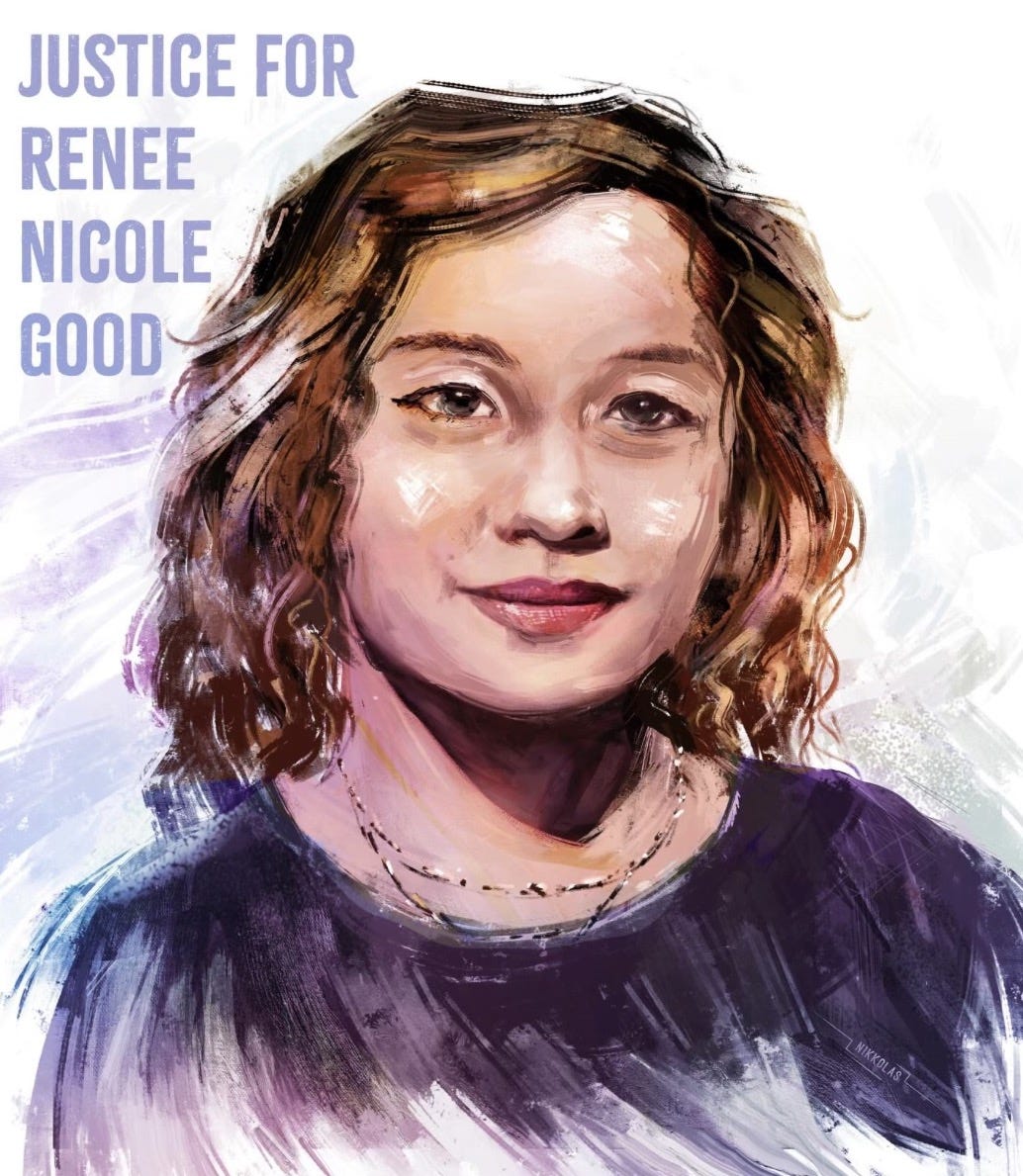
I saw someone post that the grief from this murder feels suffocating. That’s the word that stuck. Suffocating. Renee Nicole Good left behind a wife. She left behind a six-year-old who already lost his dad just a few years ago. Sitting with that reality—really sitting with it—takes the air out of your lungs.
Yesterday was exhausting in a way that sleep doesn’t touch. It’s the kind of tired that settles into your bones and stays there.
We started the day with genocide scholars warning—again—that the United States is showing recognizable early patterns of genocidal violence against transgender people. Not political commentators. Not people chasing clicks. Scholars who study how these processes actually begin. I wrote about that yesterday.
[link to yesterday’s post]
By the end of the day, Renee Nicole Good was murdered.
And before there was even space to take a breath—before grief could land, before shock could settle—the lies showed up. Calling it self-defense. Praising the shooter for “fighting for his life.” Smoothing the story until the violence sounded reasonable, even admirable.
Watching that happen in real time just wrecks you.
It’s disorienting. It makes you feel like you’re being asked to override your own senses. Like you’re supposed to swallow the story being handed to you instead of trusting what your whole body is reacting to.
That’s the kind of tired I’m talking about. The weariness that comes from watching the same patterns repeat while being told—again—that nothing is really happening.
Trust Your Body
People keep asking me how to handle moments like this. How to move forward. How not to lose hope—or lose themselves. I don’t have all the answers. I won’t pretend to. But I do have some initial thoughts. And the first one keeps coming back to the same place.
Trust your body.
Before you can explain why something feels wrong, your body has already clocked it. The tightening in your chest. That sick feeling in your stomach. The sense that something has gone terribly wrong even while people with power insist everything is under control.
Your body already knows.
There’s nothing mystical or dramatic about that. It’s how you’re designed.
Long before you can analyze a situation, your nervous system is scanning for threat. It’s paying attention to tone, pattern, speed, contradiction. It notices when words don’t line up with reality. When violence is minimized. When harm is reframed as necessary or reasonable. Your body picks up on that dissonance immediately, even if your brain is still trying to make sense of it.
You saw what you saw. A woman was murdered. In broad daylight. And instead of truth, we were given spin. No amount of repetition changes that. No confident delivery turns it into something else. That feeling of being unsettled isn’t irrational, regardless of what anyone says. It’s perception.
Many of us—especially those who grew up in fundamentalism or spent time inside it—were trained to override that perception. We were taught to doubt our instincts. To wait for more context. To trust official language, authority figures, and sanctioned explanations over lived reality. If something felt off, the assumption was that we were the problem. That we lacked faith, maturity, or understanding.
But bodies are very good at recognizing danger before we have language for it.
When reality starts getting rewritten in real time, your nervous system reacts because it’s supposed to. Confusion, tightness, fatigue, even numbness—those aren’t signs that you’re failing. They’re signs that your body is trying to protect you from overwhelm.
So if you need to step away from the noise to stay grounded, do it. Turn off the endless commentary. Put your phone down. Touch something solid. Breathe slowly. Let your system settle.
You may feel guilty for disengaging. A lot of people do. We’ve been taught that constant attention equals moral seriousness. That rest equals indifference. But stepping back doesn’t mean you don’t care. It means you’re trying to stay present without breaking.
You don’t owe the chaos your nervous system.
Staying grounded isn’t avoidance. It’s how you remain capable of clarity, memory, and action when it actually matters.
Don’t Move On
What worries me almost as much as the lie itself is how quickly we’re expected to move on.
We are not good at grief in this country. We don’t know how to sit with it. We don’t know how to make space for it without trying to fix it, rush it, or replace it with the next thing demanding our attention. We’re uncomfortable with anything that slows us down or asks us to feel something we can’t immediately resolve.
So we scroll.
We refresh.
We brace ourselves for the next headline.
One story replaces the next. One crisis blurs into another. The pace is relentless, and it’s not accidental. Chaos has a way of erasing memory. When everything feels urgent, nothing is held long enough to matter. Grief barely has time to register before it’s pushed aside by the next outrage.
But grief is information too.
Grief tells us what mattered. It tells us that a life was not disposable. It tells us that something sacred was violated. When we rush past it, we don’t become stronger—we become numb. And numbness is far easier to manage than a population that remembers.
Don’t let this one disappear and don’t hand them your energy.
That doesn’t mean you have to stay angry. Constant rage will burn you out and leave nothing usable behind. But it also doesn’t mean pretending this didn’t land. Let yourself feel the weight of it. Let it settle somewhere deeper than outrage. Let it clarify what you’re seeing instead of washing over you and moving on.
Grief doesn’t ask you to scream forever. It asks you to remember.
If we don’t allow ourselves to grieve, we lose the ability to say, this mattered.
And memory—real memory, held in the body and carried forward—is a form of resistance in a system that depends on forgetting.
Hold Power Accountable
MAGA politicians, preachers, and podcasters aren’t even trying to cover up anything anymore. They’re just defending it. Calling it justified. Calling it “good training.” Saying it was her fault. As if this violence appeared out of nowhere, as if the conditions for it weren’t deliberately created.
This is the playbook. You create the narrative. You dehumanize a group. You frame them as a threat. You light the fuse. And when the explosion comes, you point somewhere else while still holding the lighter. This is how street-level violence is prepared long before it happens. It’s the same tactic the brownshirts used in the lead-up to the Nazi takeover: manufacture fear, normalize aggression, then blame anyone but the people who made it inevitable.
What we’re watching isn’t confusion. It’s rehearsal.
But stopping there lets another group off the hook—and that failure may be just as dangerous.
Because while one side is lighting matches, the other is issuing statements. While authoritarianism is being practiced openly, Democratic leadership keeps talking about being “discouraged.” About norms. About patience. About the importance of not overreacting.
This is not the moment for disappointment.
This is the moment for resistance.
We do not need strongly worded letters. We do not need carefully hedged press conferences. We do not need leaders who are more afraid of being called divisive than of watching democracy collapse in real time.
If you cannot fight this with the same tenacity that it’s being pursued—if you cannot name the danger plainly, disrupt the machinery, and take real political risk—then you are not a safeguard against authoritarianism. You are a delay tactic.
And delay is a form of permission.
Accountability does not stop with the loudest villains. It includes the people who cling to their seats, their donors, and their careers while telling the rest of us to stay calm. It includes leaders who benefit from stability while others are being targeted, harmed, and killed.
We are not talking about hurt feelings or partisan disagreement. We are talking about the conditions that decide whether a democracy survives.
So yes—vote out the liars.
And vote out the cowards.
If you cannot grow a spine and stand up to this, you will be removed for someone who will.
Stay With What You Know
This isn’t about staying angry forever. Anger alone burns hot and then burns out. What this moment actually asks of us is something quieter and harder: staying awake.
Staying awake to what our bodies are registering even when the noise gets loud. Staying awake when the story is reframed, softened, buried, or replaced by the next manufactured crisis. Staying awake long enough to remember—not just what happened, but how it felt when it happened.
Because regardless of what they say next, regardless of how many times the truth is reworked into something more convenient, your gut already knows what’s real. That knowing doesn’t need to be constantly shouted. It needs to be protected. Held. Carried forward into how you vote, how you organize, how you refuse to forget when the midterms arrive and everyone hopes you’ve moved on.
I keep returning to that line from Fannie Lou Hamer because it isn’t dramatic or reactive. It’s honest. It’s what clarity sounds like after illusion has worn off.
Being sick and tired doesn’t mean giving up. It means you’ve reached the point where denial is no longer possible. Where pretending this is sustainable, manageable, or normal takes more energy than telling the truth.
And your body—quietly, persistently—has already been telling you that.
Very wise, good, and much-needed words. I stand with you, my friend. My heart is heavy, even as I continue to hold fast to Hope...
This is so interesting and pertinent to the whole subject of grief and anger at loss, as well as the more obvious and central point that the US is moving towards a totalitarianism (my word, not yours, Joe, but the implication is there) which those of us in other parts of the world are watching with horror and a paralysing sense of inevitability. We are not sure what we should do - though many of us are willing our leaders to stand up to the manifest evil of it more strongly. But we stand with those in the US itself who are speaking up against it. My only plea is that your resistance doesn't morph into violent opposition - in the end that will do no good, and is not the Christian way.