
Peace, With a Body Count
Why “peace through strength” always costs more than we admit

There’s a lot of emotion in the air right now. A lot of fear.
We’re barely into the new year and we’re already watching a familiar pattern unfold again: military action framed as necessity, a foreign leader removed, a new regime installed, and American interests lining up behind the scenes to extract whatever can be extracted. It’s being narrated as stability. As order. As something unavoidable.
At the same time, there are real people on the ground who have lived under corruption and violence for years. If you’ve endured a decade under an authoritarian leader and that person is suddenly gone, of course there’s relief. Of course there’s celebration. Anyone pretending otherwise isn’t being honest.
Both of those things can be true at the same time.
But of all the concerns I have—and I have many—this is the one that scares me the most. Not just the military action itself, but how openly and enthusiastically it’s being blessed.
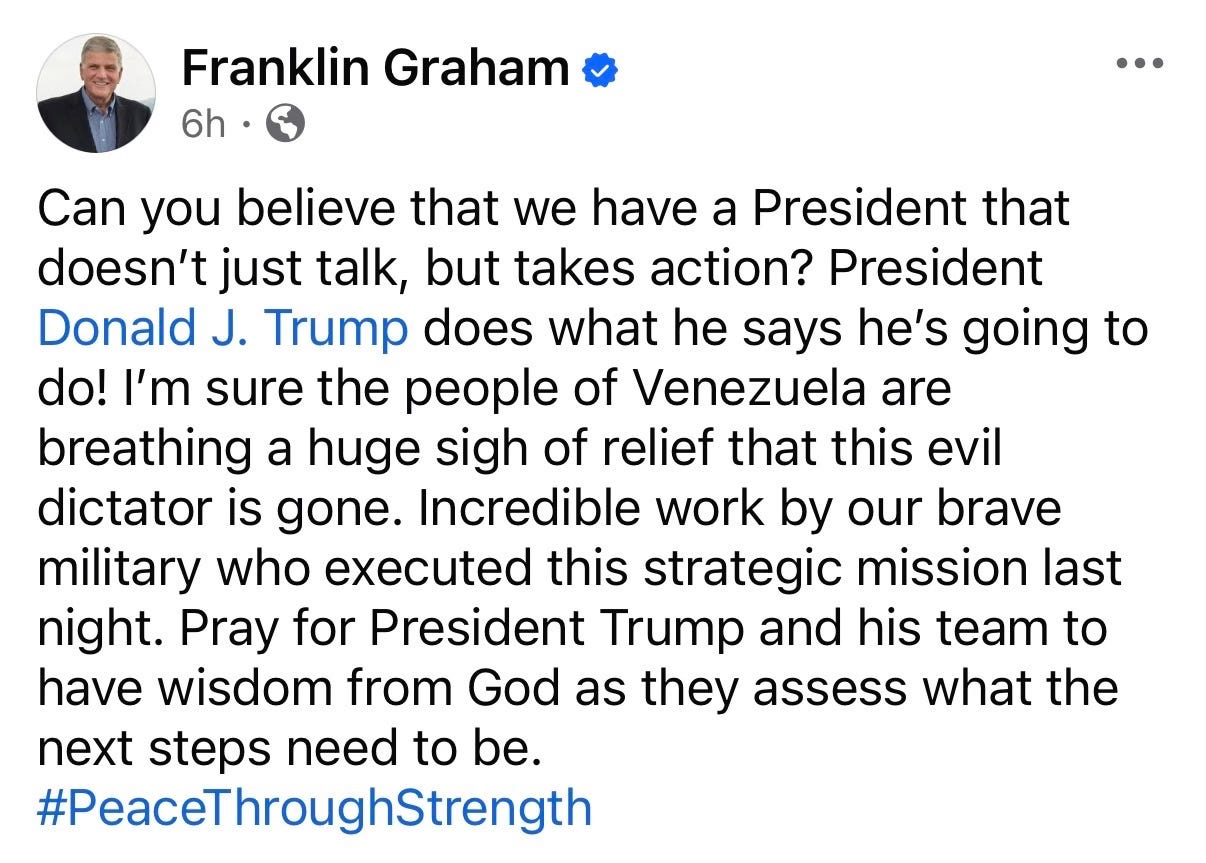
Here’s the post that caused my blood pressure to skyrocket. Franklin Graham wrote:
“Can you believe that we have a President that doesn’t just talk, but takes action? President Donald J. Trump does what he says he’s going to do! I’m sure the people of Venezuela are breathing a huge sigh of relief that this evil dictator is gone. Incredible work by our brave military who executed this strategic mission last night. Pray for President Trump and his team to have wisdom from God as they assess what the next steps need to be.
#PeaceThroughStrength”
That hashtag is terrifying.
Not because people want peace. We all do. But because of what that phrase has always meant in practice—and because of how casually it’s being baptized with God-language.
We’ve always had wars framed as “freedom” or “security.” That’s not new. What is new is how blatantly large segments of the American church are celebrating military power as a sign of faithfulness. Not with grief. Not with lament. Not even with caution. But with applause and certainty.
The moment I read that post, my mind went somewhere unexpected—not to Scripture or theology, but to a line from a fictional antihero (Peacemaker) that’s meant to expose the logic of violence by saying it out loud:
“I cherish peace with all my heart. And I don’t care how many men, women and children I have to kill to get it.”
That line works as satire because it refuses to hide the cost. That’s what makes peace through strength so dangerous—it promises peace while obscuring the bodies required to get there.
This isn’t some recent deviation. The majority of the white evangelical church has always been comfortable with empire. It has always made room for violence as long as it’s framed as law and order. This hashtag isn’t a mistake. It’s a confession. It tells the truth about which side of history the church has repeatedly chosen when power feels strong.
So when I read peace through strength, I don’t hear wisdom. I hear branding. I hear the same old promise that force will bring order if we just let it do its thing. That violence will create stability. That power doesn’t need accountability if it claims to be righteous.
And once God’s name gets attached to that kind of power, it becomes almost impossible to challenge. Question it and you’re accused of being naïve. Or unpatriotic. Or told you don’t understand how the world really works. But empires always talk about safety and stability right before they use violence to force compliance. That’s not a conspiracy. It’s history.
What’s especially chilling isn’t just the rhetoric—it’s how normal it sounds to so many people. How easily faith becomes a stamp of approval. How rarely anyone pauses to ask who pays the price for this version of peace, or whose lives are considered expendable along the way.
And here’s the part that matters most to me.
Jesus didn’t die because he was too gentle. He didn’t die because he failed to seize power. He died because he refused to play along with that system. He refused to bless empire. He refused to confuse domination with salvation. He refused to sanctify violence, even when doing so would have made him safer.
So when the church starts cheering military force and calling it faith, it isn’t being bold. It isn’t being biblical. It’s doing what it has always done when empire feels strong—blessing it, benefiting from it, and hoping no one looks too closely at the cost.
The problem isn’t the desire for peace. The problem is how quickly we accept peace that requires blood to achieve it—and how easily faith is used to justify that trade.
And if that doesn’t unsettle us, it probably should.
Empire always seeks peace through victory, domination and strength. As was said of the Romans, “they make a desert, and call it peace.”
Like the Pax Romana. So-called ‘peace’ bought with blood, violence, power, oppression, genocide, brutality, empire