
Jubilee Without Liberation
When political Christianity borrows the language of freedom while defending systems that keep people burdened

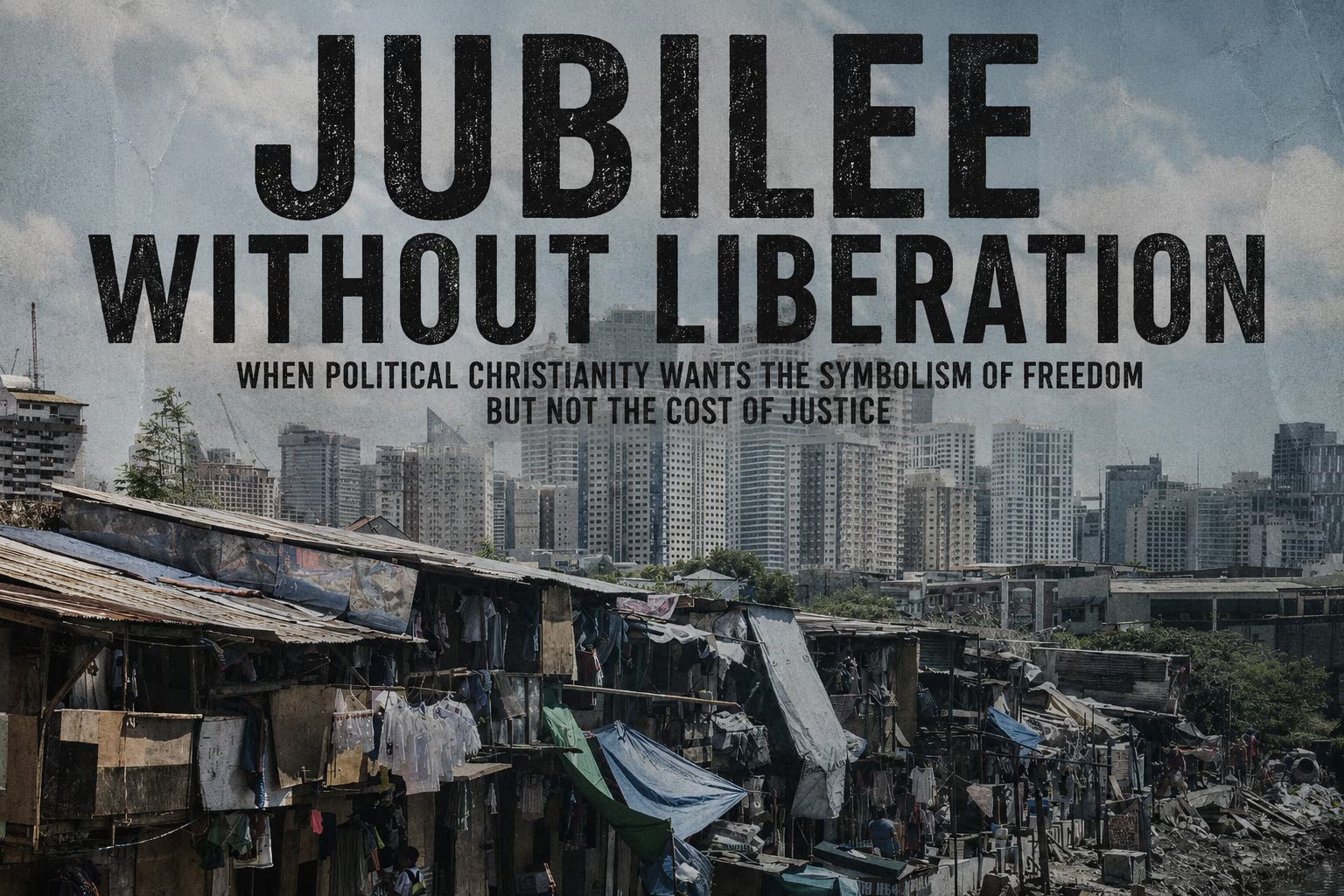
This weekend, Washington D.C. is hosting a major celebration connected to the nation’s 250th anniversary. The language surrounding “Freedom 250” is filled with themes like renewal, blessing, restoration, and national purpose. It is being branded as a Jubilee of prayer, praise and thanksgiving.
I understand why that resonates emotionally. Jubilee sounds hopeful. It sounds holy. It sounds like freedom finally arriving for people who have carried too much for too long.
But the deeper I’ve revisited the actual Jubilee texts, the harder it has become to ignore the distance between the biblical idea and the version of freedom so often promoted inside modern political Christianity.
In Scripture, Jubilee was not a national display or some celebration. It was about interruption. It interrupted debt cycles. It interrupted generational poverty. It interrupted the endless consolidation of wealth and power into fewer and fewer hands. Jubilee was a direct challenge to economic systems that left people trapped.
Many Americans do not feel liberated right now. They feel exhausted.
People are not imagining the pressure they are under. Grocery prices are currently up 2.9% year-over-year, including a 0.7% jump in April alone, the largest single-month increase in nearly four years. Altogether, grocery costs have climbed around 24% since 2020. Inflation recently rose to 3.8%, the highest level in three years, driven heavily by surging fuel costs tied to instability in the Strait of Hormuz during the conflict with Iran. Gas prices have jumped 28.4% year-over-year. Here in Florida, regular unleaded is averaging roughly $4.30 per gallon, more than 40% higher than this time last year.
And yet the political rhetoric keeps coming wrapped in the language of blessing, prosperity, and divine favor while ordinary families feel increasingly cornered.
What Jubilee Actually Was
Most Christians have heard the word Jubilee, but very few have been taught what it meant.
The primary Jubilee text is Leviticus 25. Every fiftieth year, Israel was commanded to reorder its economic life in ways that sound almost shocking to modern ears.
The chapter opens the Jubilee legislation this way:
In addition, you must count off seven Sabbath years, seven sets of seven years, adding up to forty-nine years in all. 9 Then on the Day of Atonement in the fiftieth year,[a] blow the ram’s horn loud and long throughout the land.10 Set this year apart as holy, a time to proclaim freedom throughout the land for all who live there. It will be a jubilee year for you, when each of you may return to the land that belonged to your ancestors and return to your own clan — Leviticus 25:8–10
That last verse ended up engraved on the Liberty Bell. What usually gets left out is everything surrounding it.
The chapter is relentlessly specific. Debts released. Land returned to original families. People who had sold themselves into indentured labor to survive freed and restored. The text describes a society where economic catastrophe was never permitted to become permanent:
If one of your fellow Israelites falls into poverty and is forced to sell some family land, then a close relative should buy it back for him. 26 If there is no close relative to buy the land, but the person who sold it gets enough money to buy it back, 27 he then has the right to redeem it from the one who bought it. The price of the land will be discounted according to the number of years until the next Year of Jubilee. In this way the original owner can then return to the land. — Leviticus 25:25–27
These passages run deeper than charity. The text is not asking the wealthy to be generous. It is setting hard structural limits on how much advantage one person can accumulate over another:
If one of your fellow Israelites falls into poverty and cannot support himself, support him as you would a foreigner or a temporary resident and allow him to live with you. 36 Do not charge interest or make a profit at his expense. Instead, show your fear of God by letting him live with you as your relative. 37 Remember, do not charge interest on money you lend him or make a profit on food you sell him. — Leviticus 25:35-37
If one of your fellow Israelites falls into poverty and is forced to sell himself to you, do not treat him as a slave. 40 Treat him instead as a hired worker or as a temporary resident who lives with you, and he will serve you only until the Year of Jubilee. 41 At that time he and his children will no longer be obligated to you, and they will return to their clans and go back to the land originally allotted to their ancestors. — Leviticus 25:39–41
Then the text says something even more shocking to our modern capitalist ears:
The land must never be sold on a permanent basis, for the land belongs to me. You are only foreigners and tenant farmers working for me. — Leviticus 25:23
That is an entirely different way of imagining society than the one most Americans have inherited. Ownership itself is relativized. No one’s claim to accumulation is absolute, because nothing ultimately belongs to the accumulator.
The biblical writers understood that economies do not stay neutral for long. Wealth consolidates. Power concentrates. Debt multiplies. People at the bottom become increasingly vulnerable while those at the top gain more control over the system itself. Jubilee existed because Scripture recognized how quickly societies drift toward permanent inequality if nothing interrupts the cycle and it refused to treat that drift as natural or inevitable.
Jubilee was not simply about personal generosity. It was structural. It was legislated disruption.
The Distance Between Scripture and Political Theater
Modern political Christianity often wants the emotional power of biblical language without accepting the economic implications attached to it. It wants the aesthetic of jubilee without the economics of jubilee.
Freedom becomes symbolic instead of material. Something you wave from a stage rather than something measured by whether people can actually afford housing, groceries, healthcare, or basic stability.
Right now, the United States has levels of wealth concentration that would have horrified the economic imagination behind Jubilee. The richest 1% of Americans now hold roughly as much wealth as the bottom 90% combined. Meanwhile, millions of people sink deeper into debt while wages fail to keep pace with the cost of living.
Much of political Christianity remains far more animated by culture war outrage than by any of that.
The tension becomes even more visible in the polling. Donald Trump’s current approval nationally sits between 35% and 43% depending on the poll. Ballotpedia places him at 40%, RealClearPolitics at 40.2%, Quinnipiac at 38%, CNN/SSRS at 35%. However, among committed MAGA Republicans, his approval remains around 85%.
That distance found in that gap says something. Outside the movement, Americans are increasingly skeptical that the promises match the reality they are living. Inside the movement, political identity has fused so completely with religious and cultural identity that criticism feels personal and existential rather than political.
When people feel afraid of losing the world they recognize, symbolism becomes emotionally powerful. National identity starts feeling sacred. Political leaders begin sounding like protectors of order itself. None of that is hard to understand. But emotional attachment cannot change material reality and material reality matters.
Jesus and the Language of Release
What unsettles me most about all of this is how directly Jesus rooted his public ministry in Jubilee imagery.
In Luke 4, Jesus stands in the synagogue and reads from Isaiah:
The Spirit of the Lord is upon me, for he has anointed me to bring Good News to the poor. He has sent me to proclaim that captives will be released, that the blind will see,
that the oppressed will be set free… — Luke 4:18
That language is deeply connected to Jubilee: release from crushing burdens, restoration, relief for people living beneath systems that drained them. And what strikes me every single time I reread that passage is how quickly admiration turns to hostility once people realize Jesus is serious about it.
Liberation always sounds beautiful until it threatens systems that benefit us.
It is possible to speak constantly about freedom while defending economic realities that leave people trapped. It is possible to quote Scripture about liberty while supporting policies that make ordinary life more precarious for millions of families.
I am not arguing ancient Israel can be copied and pasted onto modern America. But Christians invoking Jubilee language publicly should at least reckon honestly with what Jubilee was designed to prevent: a society where wealth pools endlessly upward, where debt becomes generational, and where ordinary people carry increasingly heavier burdens while those at the top remain insulated from the consequences. That was precisely the kind of economic reality Jubilee kept interrupting.
The Questions More Christians Are Starting to Ask
More Christians are feeling disoriented because they simply cannot reconcile the teachings of Jesus with an increasingly aggressive fusion of nationalism, political spectacle, and economic policies that seem to leave ordinary people struggling harder than before.
These Christians are not abandoning the faith, they aren’t anti-American and they aren’t being manipulated by “the left”.
So many were raised believing Christianity meant caring for neighbors, feeding hungry people, protecting the vulnerable, and building communities shaped by compassion. Then they look around and see billionaire worship, rising authoritarian rhetoric, endless grievance politics, and economic pressure crushing working families while Christians cheer from the sidelines because their side still feels culturally dominant.
That creates real cognitive dissonance. Some people are beginning to realize they were taught to recognize moral failure almost everywhere except inside systems they already belonged to. That realization can be disorienting. It can also be clarifying.
What Jubilee Would Force Us to Confront
Taking Jubilee seriously would require far more than patriotic celebrations wrapped in biblical imagery.
It would mean asking why millions of people work full time and still cannot make ends meet. It would mean examining healthcare systems that bankrupt families, housing markets increasingly controlled by corporations, and an economy where the richest continue accumulating staggering wealth while ordinary people absorb rising costs at every level of life.
Jubilee would ask whether an economy is serving human beings or consuming them. It would ask whether freedom is actually reaching people carrying the heaviest burdens. It would ask whether Christians care more about preserving hierarchy or relieving suffering.
Those are uncomfortable questions because they pull liberation out of the realm of symbolism and into the realm of policy, economics, and lived reality. Once that happens, biblical language becomes much harder to use as a decoration for power.
One Last Thing
The longer I sit with the Jubilee texts, the less patience I have for religious rhetoric disconnected from material life. Scripture never treated economics as separate from morality. The prophets spoke continually about exploitation. Jesus spoke constantly about wealth, debt, power, and the vulnerable. The biblical story keeps asking what kind of society we are building and who benefits from it.
Jubilee still feels dangerous and not because it is radical in some modern partisan sense, but because it refuses to let freedom remain abstract. It keeps dragging the conversation back to the people carrying the weight of the system.
Maybe that is the question sitting underneath all of this. Not whether America knows how to celebrate freedom. But whether we still recognize liberation when it starts costing the powerful something.