
Christian Supremacy
Deconstructing Fundamentalism

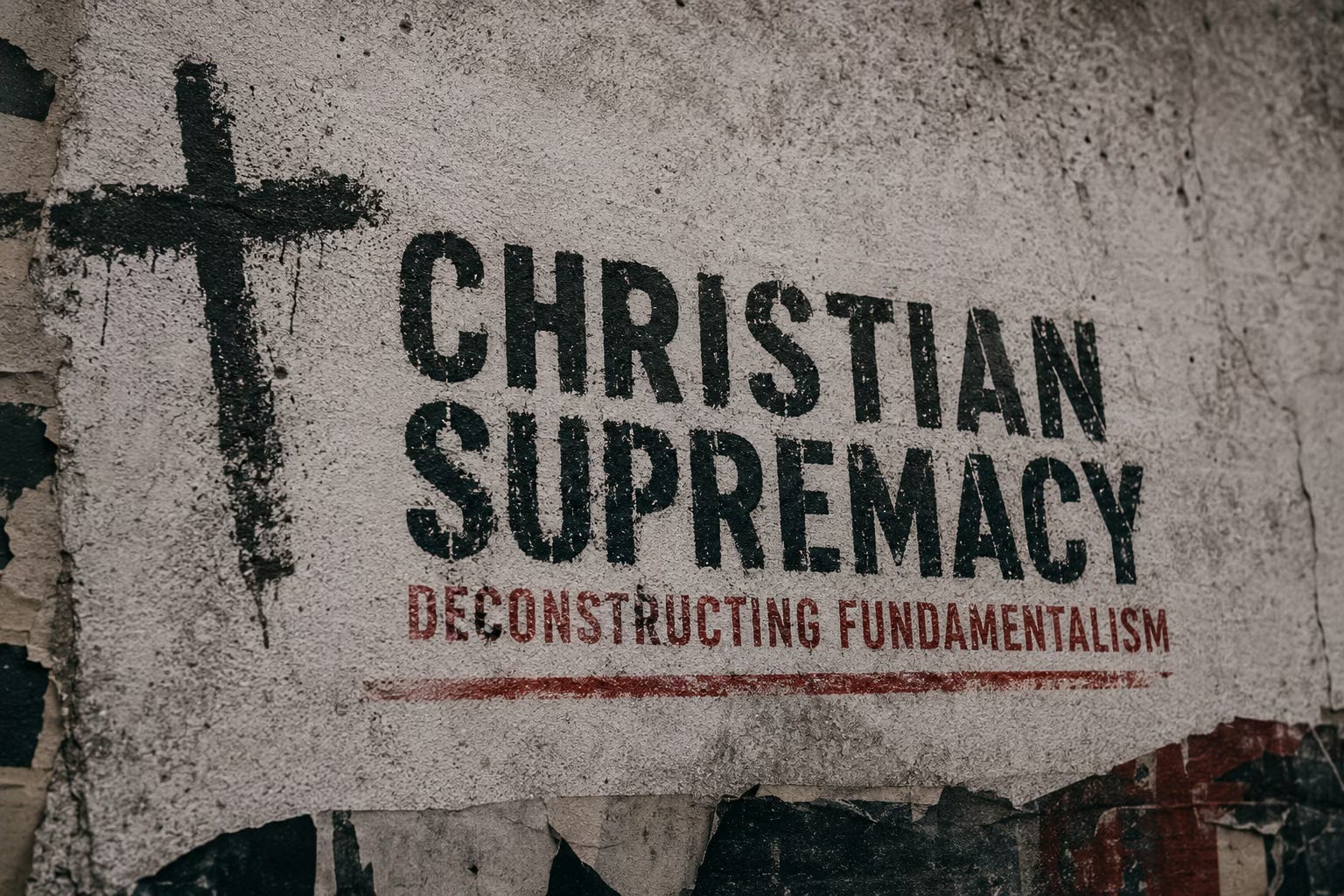
This is week 14 of a series I am doing every Wednesday called "Deconstructing Fundamentalism". This won't be an exhaustive approach to deconstructing these harmful teachings. Instead they are my reflections on the things that cracked my cognitive dissonance and helped lead me to a healthier Christian spirituality.
There’s a particular kind of fear that forms in you when you grow up believing almost everyone is wrong.
Not simply mistaken, but spiritually dangerous.
Outside the truth.
Deceived.
That was my spiritual heritage.
The church I grew up in constantly reinforced the idea that we were surrounded by corruption. The “world” was dangerous. Secular culture was dangerous. Other religions were dangerous. Even other Christians could become dangerous if they believed the wrong things in the wrong way.
And the boundaries never stopped tightening.
We did not just believe Christianity was true. We believed our denomination had preserved the purest version of it. Everyone else was compromised somewhere along the line. Some groups were seen as confused. Others were seen as outright threats.
I grew up outside St. Louis, where Catholicism has a deep cultural presence, and my church treated the Catholic Church with an intense open suspicion. We passed around Chick tracts showing the Pope as the future Antichrist. Every sermon series about the end times eventually circled back to Rome. Catholicism was not presented as another Christian tradition that interpreted things differently. It was framed as something spiritually dangerous sitting just outside the walls.
When I chose to attend a Christian college outside our denomination, my pastor pulled me aside and warned me they would “lead me astray.” The school was still conservative. Still deeply Christian. Still committed to the authority of Scripture. They simply were not our particular version of Christian.
That alone was enough.
Looking back, what strikes me is how Christian supremacy works by continually narrowing the circle while convincing the people inside it that they are defending truth. The system trains you to see your group as spiritually safer, morally clearer, and/or closer to God than everyone outside it. I won’t speak for anyone else but this made exclusion feel righteous. Being separate felt like we were holy. And the smaller that circle got, the more sacred it seemed.
When Faith Becomes Superiority
At some point, the structure starts producing questions it cannot answer cleanly.
If the same Spirit is guiding all Christians into truth, then why are there tens of thousands of denominations, all claiming the Spirit led them to different conclusions?
Sit with that for a moment.
Why do sincere believers reading the same Bible arrive at radically different understandings of women, communion, baptism, salvation, spiritual gifts, sexuality, and authority? Who decides which interpretation counts as faithfulness and which one counts as deception? And who gave them that authority?
Christian supremacy survives by convincing people that certainty equals faithfulness. The more certain the system becomes, the easier it is to divide the world into insiders and outsiders.
That division creates a kind of emotional security, because complexity disappears. The world becomes easier to sort. But it also creates spiritual hierarchy. Some Christians become “real” Christians while others become “not so much”. Other religions become enemies. People outside the faith stop being neighbors and start becoming threats to manage, convert, defeat, or fear.
This is why Christian supremacy is more than believing Christianity is true. Plenty of people believe their religion is true. Christian supremacy begins when Christianity gets used to rank human beings and becomes a justification for dominance rather than an invitation into love.
It rarely announces itself that way. It almost never does.
The Fear Underneath It
The deeper I’ve looked at this, the more convinced I’ve become that Christian supremacy runs on fear more than hatred.
When people feel the world changing too quickly around them, they tend to move toward stronger authority and sharper boundaries. Diversity begins feeling destabilizing. Religious pluralism begins feeling threatening. The presence of different beliefs interrupts the assumption that one group should remain at the center of public life.
That fear is deeply human. Most people inside these systems are not cruel. Many are sincere, generous, loving people trying to protect what they believe is sacred. Supremacy rarely survives by presenting itself as domination. It survives by presenting itself as protection.
Groups who perceive themselves as losing cultural ground often become more defensive of hierarchy, and the fear is not always conscious. It often sounds moral.
“Society is collapsing. Truth is disappearing. Christianity is under attack.”
Underneath much of that is anxiety about no longer being centered.
That is why “Christian America” carries so much emotional force. Christianity in America has never functioned only as personal spirituality. It shaped public morality, education, politics, social expectations, and national identity. As that dominance has loosened, many Christians have experienced the change as persecution rather than pluralism.
Once fear is spiritualized, protecting dominance becomes a holy duty.
This is where things can get especially dangerous and not because of cruelty but because when ordinary human fear gets wrapping in divine language it transforms into spiritual warfare. People begin believing they are defending God when they are often defending familiarity, power, and the world as they’ve always known it.
The irony is that Jesus resisted exactly this kind of anxious power-holding.
In Mark 9, the disciples tell Jesus they tried to stop someone casting out demons in his name because “he was not following us.” That phrase exposes the instinct immediately. Not following us. Not inside our group. Not under our authority.
Jesus responds: “Do not stop him. Whoever is not against us is for us.”
The disciples were trying to protect the boundaries of the group. Jesus pushed in the opposite direction. He kept doing that. It was not an accident or an exception. It was the pattern of his life.
If you’re reading this and something in you is pushing back, I would encourage you to meet it with curiosity rather than judgement. That tension is worth paying attention to. It might just be the most honest thing happening in you right now.
What the Fruit Reveals
One of the key passages that slowly unraveled things for me was Matthew 7:16.
“You will know them by their fruit.”
Jesus puts the weight on what a system produces, not what it claims. The question we’re called to ask is not how confidently it speaks but what actually grows.
What kind of people are being formed by Christian supremacy? What happens to empathy inside a faith organized around insiders and outsiders? What happens to curiosity when certainty becomes sacred? What happens to compassion when other religions are primarily viewed as threats? What happens to humility when your group believes it holds truth more purely than everyone else?
Theology always forms people. That formation isn’t limited to intellect. It forms in the gut, in the posture, in how you look at a stranger or someone who disagrees with you politically or someone who exists outside the approved categories.
Christian supremacy produces a particular kind of person. Fear begins sounding like discernment. The need to defend Christianity becomes more urgent than the call to live and love like Jesus. Over time, the faith becomes organized around protecting its own position.
That is not the portrait of Jesus I find in the Gospels.
Jesus moved toward the people religion had placed outside the circle. Samaritans. Romans. Gentiles. The categories that organized religious purity in his day never seemed to govern his imagination the way they governed everyone around him. He was not anxious about the boundaries. He walked through them as if they were not quite as solid as everyone else assumed.
Truth mattered to Jesus. Love did too. He never treated them as separate things.
Christian supremacy almost always does.
What Begins to Grow After
One of the hardest parts of moving out of Christian supremacy is learning how to hold faith without needing your group to sit above everyone else.
That can feel disorienting because supremacy provides emotional clarity. It tells you who is safe, who is dangerous, and who is right. It gives you a world that already feels settled before you arrive at it. The lines are drawn. The answers are waiting before the questions are even asked. There is nothing you need to do or decide other than just holding the line.
I lived inside that world for far too long. So much so, that I even taught it to other people.
When someone would ask how we could know Christianity was the “right” religion, I always had some polished answer ready. An apologetics line I had picked up from a sermon or a Bible study or a conference somewhere. I could say it confidently. I could defend it. I could make it sound convincing.
The strange thing is… I cannot remember what I used to say.
The “truth” I once defended with absolute certainty turned out to be so important, so life changing that it left almost no lasting impression on me at all. It was not deep conviction so much as inherited certainty. I had been taught how to answer without ever being taught how to wrestle.
That is one of the more overlooked losses inside Christian supremacy. It replaces curiosity with defensiveness. It trains people to protect conclusions rather than remain open to being changed. Faith becomes something you guard instead of something that keeps unfolding in you.
Leaving that behind felt terrifying at first because I had confused certainty with faith. I thought if the certainty disappeared, God would disappear with it.
That did not happen.
What disappeared was the need to always be right, the pressure to defend Christianity against every question, every doubt, or every difference. What disappeared was the fear that another perspective might undo everything if I looked at it too closely.
On the other side of that, something much healthier started growing.
I no longer need other people to validate my faith in order for it to matter. I no longer need Christianity to dominate culture for it to be meaningful to me. There is no book I am afraid to read. No question that feels threatening. No conversation that requires panic or defense.
Because faith rooted in love does not need supremacy in order to survive.
The deeper I’ve moved into the actual teachings of Jesus, the harder it has become to reconcile him with a version of Christianity obsessed with power, cultural control, fear of outsiders, and the desperate need to win. Jesus seemed remarkably free from that anxiety. He was not scrambling to protect God from difficult questions or from people outside the religious boundaries of his day. He moved toward people with a kind of openness that unsettled everyone around him.
Those realizations slowly changed the questions I asked.
The questions stopped being whether Christianity could reclaim dominance or about how to prove we were right and everyone else was wrong. It stopped being who was safely inside and who was standing out in the cold.
The question became simpler and more difficult at the same time.
What kind of people are we becoming?
If our faith requires fear, control, and supremacy in order to sustain itself, we owe ourselves the honesty of looking at what that system is actually producing.
If following Jesus is making us more compassionate, more humble, more honest about our own limitations, and more capable of loving people outside our tribe… then maybe that has always been closer to the point than winning the argument ever was.
One Last Thing
Sometimes I think about that kid outside St. Louis, reading and passing around those Chick tracts, absolutely certain he was holding the truth in his hands.
I don’t want to argue with him anymore. I’m not embarrassed by him either. He was doing the only thing he knew how to do. He was trying to be faithful inside a world that had handed him very small walls and called them the whole of God.
What I want to give him now is not a better argument. Instead, I want to give him just a little more room…
Room to wonder.
Room to be wrong.
Room to find out that the ground does not actually disappear when the certainty does.
He would have called that dangerous.
I call it the beginning of something.