
A Higher Responsibility
When the loudest churches choose cruelty, this church chose care

I don’t know about you, but it feels like every time I open my phone, I’m hit with another story about some white-nationalist, MAGA-flavored church doing something harmful. There’s always another clip: a pastor celebrating cruelty, a congregation cheering on policies that hurt the most vulnerable, somebody turning Jesus into a mascot for whatever political war they’re waging this week.
I know we’ve all gotten used to it — but I swear, it chips away at something inside you.
It’s soul-sucking.
It’s heavy in a way you don’t even recognize until you feel it lift.
And maybe that’s why this story hit me so hard.
Before I get to that, let me tell you a quick piece of my own history so you know where I’m coming from.
Years ago, I worked at a church up north — and I learned really quickly what their actual priorities were. They had a massive mortgage. And because of that mortgage, we did not cancel church.
Ever.
It didn’t matter if the roads were covered in ice.
It didn’t matter if the city was telling people to stay home.
It didn’t matter if it was literally unsafe to be on the road.
We still had to show up.
Every staff member.
Every volunteer team.
No exceptions.
Because the tithes had to come in so the building payment could go out.
I will never forget walking across a frozen parking lot at 7 or 8 in the morning — the kind of cold that takes your breath away — because service had to happen.
Not because people needed warmth or community or spiritual care.
But because the bank was waiting.
And that does something to you.
It teaches you — even if no one says it out loud — that ministry is often less about people and more about keeping the machine running.
It teaches you that compassion is optional, but Sunday is not.
It teaches you that the church will risk everything except its budget.
So with that backdrop in my heart… I came across something different recently.
Something small but holy.
Something that stopped me in my tracks.
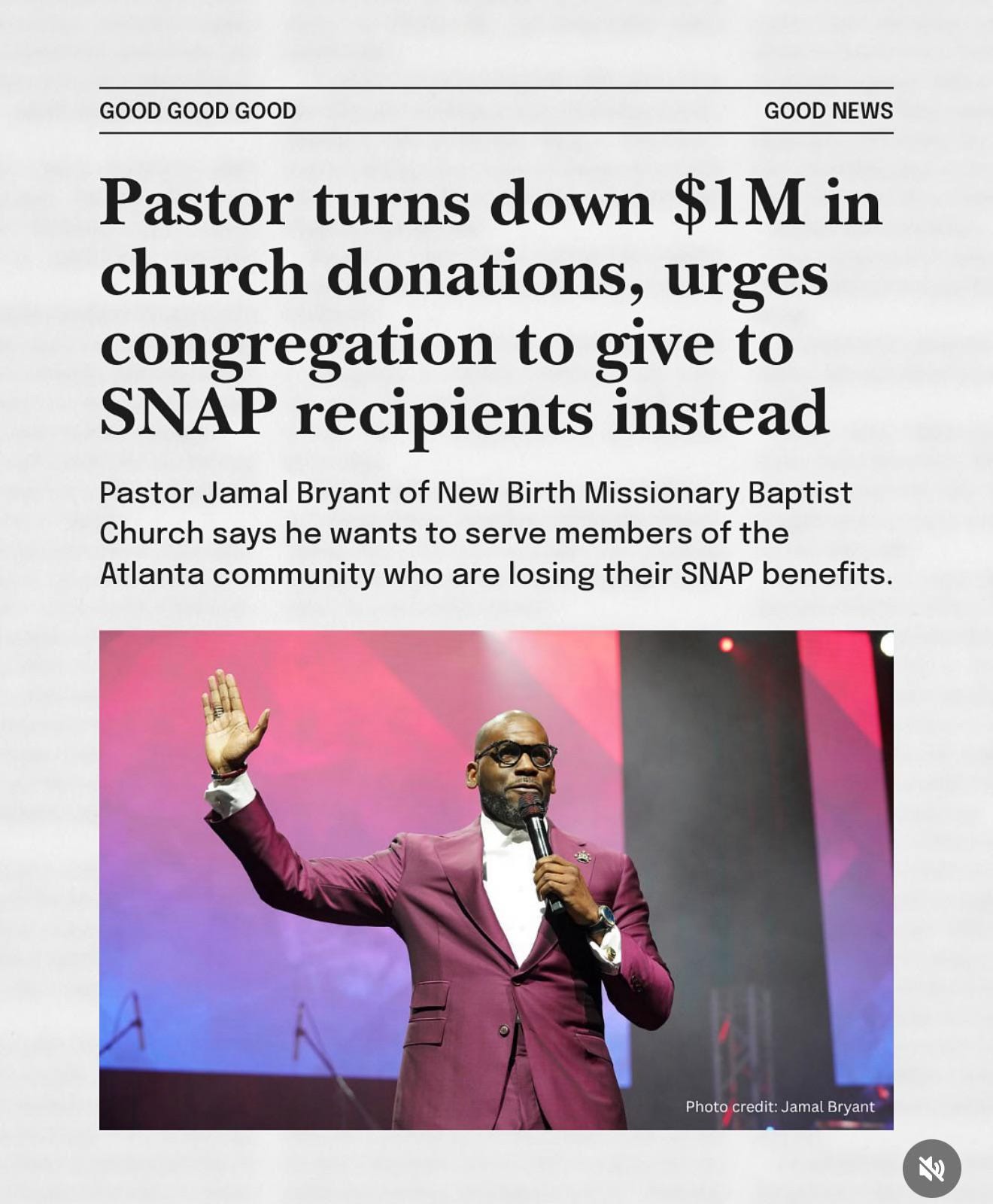
At New Birth Missionary Baptist Church in Atlanta, Pastor Jamal Bryant got up on a Giving Sunday — which, if you’ve ever been in church world, you know is a big one — and he canceled the offering.
Canceled it.
And then he said this:
“I didn’t feel like it would be right to ask people to march down with $5,000, $2,000, $3,000, and $1,000, when people don’t know how they’re going to pay their rent, they don’t know how they’re going to take care of their kids, don’t know how it is that they’re gonna eat. I know this ain’t popular, I know this ain’t going to go viral. They always talk about the negative stuff churches do.
But I felt like we had a higher responsibility.”
A higher responsibility.
And the moment I heard it, something in me softened.
Because here we are in this dark, heavy season — watching the loudest churches make the coldest decisions — and suddenly there’s this quiet little beam of light from Atlanta. A pastor standing in front of thousands of people and saying, “Nope. We’re not doing that today. Not while our neighbors are hungry.”
He told his congregation,
“Take what you were going to give here and go help the families who just lost their SNAP benefits.”
No manipulation.
No guilt trip.
No slick branding.
Just a simple, steady, human thing:
People are struggling.
Let’s go meet the need.
And I can’t explain it — but that kind of goodness hits different when it comes from church spaces. I think it’s because so many of us have been shaped by churches that protected buildings over people. By pastors who guarded the budget like it was sacred.
By systems that cared more about Sunday attendance than Monday hunger.
So when a church steps out of the script — even for a moment — it feels like someone cracking open a window in a stuffy room.
Like fresh air.
Like possibility.
Like hope.
And not hope in a vague, inspirational quote kind of way.
Hope in a lived, embodied, “we actually mean this” kind of way.
It reminded me that faith doesn’t have to be a performance.
It doesn’t have to be tied to a mortgage or a political agenda.
It doesn’t have to shout.
Sometimes faith is just… choosing to do the most good for the most people.
Choosing a higher responsibility.
Choosing each other.
Maybe — just maybe — that’s enough to keep going in a season that feels unbearably heavy.
When the loudest religious voices try to steal the story, every little flash of real goodness matters. And this one mattered to me.